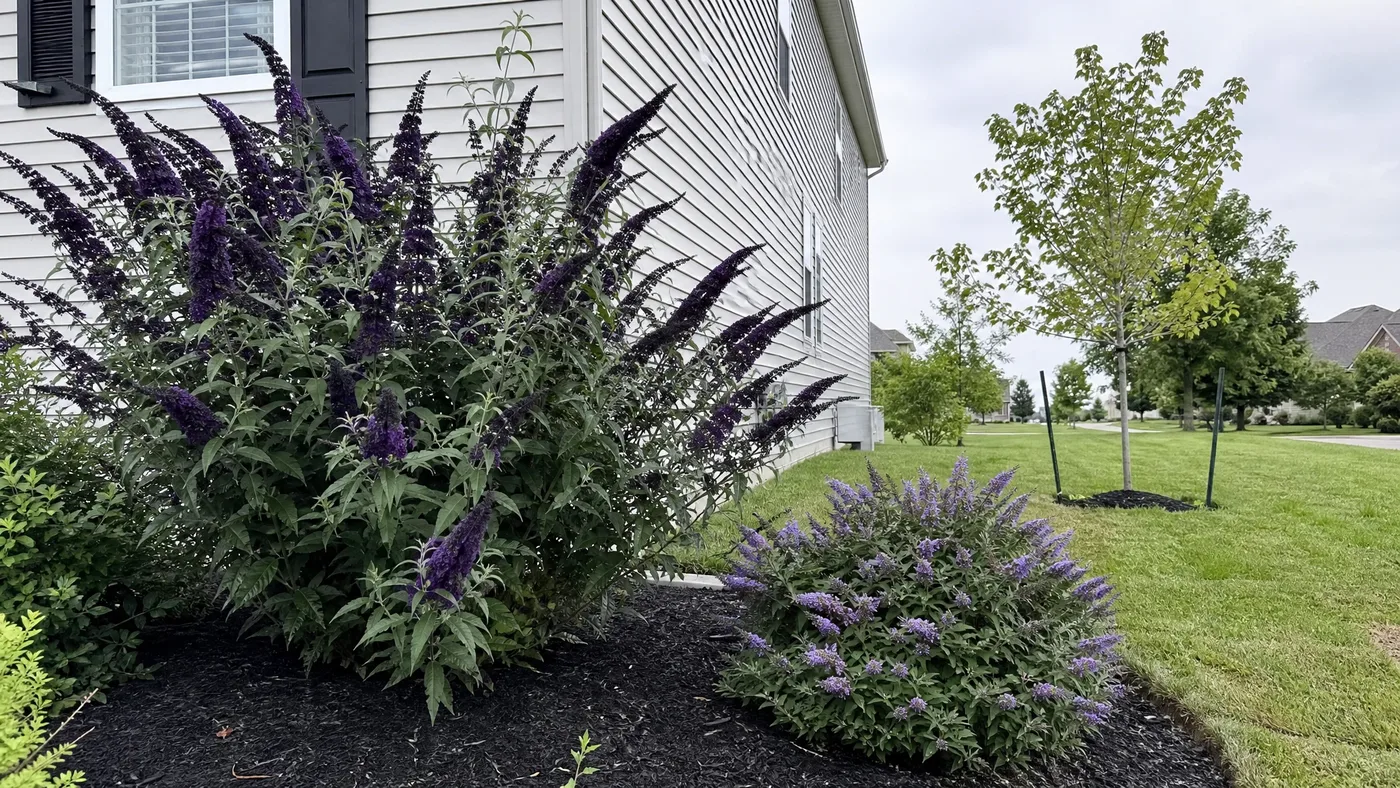
Black Knight vs Miss Violet Butterfly Bush: Size and Color
How many feet of open ground sit between your fence and your path? Measure it before you go any further, because that number sorts these two plants faster than any tag. Put Black Knight in a narrow strip and it ends up chopped to stubs every spring, leaning over the walkway, or smothering its neighbors. Put Miss Violet in a big empty bed and it sits there looking lost for years.
Both are butterfly bushes with purple spikes that bloom on new growth, so people assume they are interchangeable. They are not. In this article, we'll go through the size gap, the difference in flower color, where each plant belongs in a bed, how to fix dull blooms, and how to prune each one.
Tall and Arching, or Low and Rounded?
The size gap is the whole decision, so we start with numbers rather than photos. Everything else in this guide follows from them.
Black Knight has an ultimate height and spread of 2.5 to 4 meters, which is about 8 to 13 feet each way. It is a vigorous shrub with somewhat arching growth. Miss Violet grows 4 to 5 feet tall and equally as wide, with a compact, branching, semi-upright habit and dense foliage.
The table lays the two side by side.
| Trait | Black Knight | Miss Violet |
|---|---|---|
| Mature height | About 8–13 feet | 4–5 feet (NC State) |
| Mature spread | About 8–13 feet | 4–5 feet (NC State) |
| Habit | Vigorous, somewhat arching | Compact, branching, semi-upright, dense |
| Flowers form on | Current year's growth | New wood |
| Time to maturity | 5–10 years | Not stated |
You may see compact butterfly bushes listed at 2 to 3 feet. Do not plan around that figure for Miss Violet. A plant that reaches 4 to 5 feet wide needs that room, and that is the measurement we trust.
The Fence-to-Path Test
Take the gap you measured and read it against the table. The rule is simple, and it assumes you are not going to fight the plant every year.
If the open ground is under about 5 feet wide, Miss Violet is your plant. If it is 8 feet or more, with real headroom above, Black Knight fits. Between 5 and 8 feet is the awkward zone. Miss Violet fits comfortably there, and Black Knight only fits if you accept a hard pruning routine every spring.
Why Young Plants Mislead
A nursery pot hides the final size, and that is where most of the trouble starts.
Black Knight takes 5 to 10 years to reach maturity, so a new plant looks harmless in a 6-foot gap. Three summers later it is leaning on the path. Plan for the mature figure, not the pot. Both plants are rated for USDA zones 5 through 9, so hardiness will not decide this for you. Size will. Our guide on how big a Black Knight gets goes further into the growth curve.
Black Knight Butterfly Bush Spikes Against Miss Violet's Purple
Color is the second question, and the answer is subtler than "dark versus light." Both plants are purple, just at different depths.
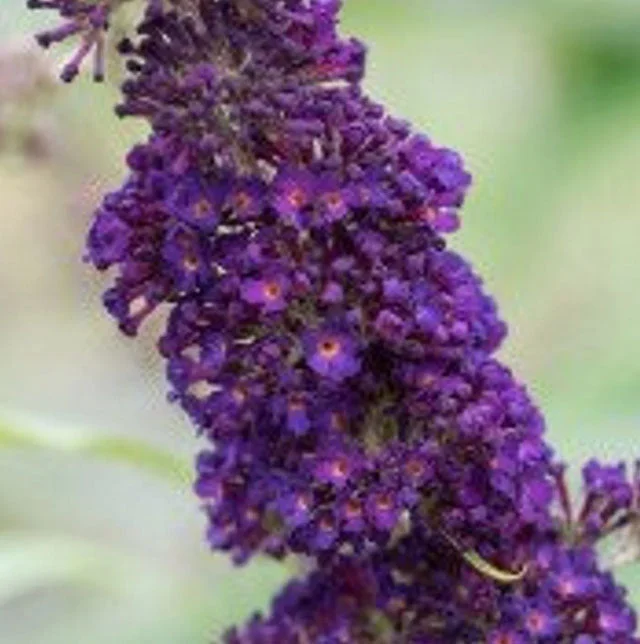
Black Knight carries scented, deep purple flowers in elongated panicles at the tips of the current year's growth, and in the garden the spikes read as near-black beside most other purples. The species itself is lilac with an orange throat, so Black Knight is a clear step away from the plain wild type.
Miss Violet's flowers are a rich purple, sometimes called "grape jelly." Beside Black Knight, that reads as the brighter, juicier of the two.
What Each Looks Like Beside the Other
If you are planting both, the pairing matters more than either plant alone.
Black Knight's dark spikes absorb light, so they look best against something pale: a light fence, a silvery neighbor, or the whitish undersides of its own lance-shaped leaves when wind flips them. Miss Violet's brighter purple holds its own against green and stands out in front of the darker plant. Set together, the lighter shrub in front brings out the depth of the darker one behind it.
Scent and Season
Both bloom through the warm months, so color is not the only sensory difference.
Black Knight's flowers are scented, since the species has a honey-like fragrance, and it blooms from June to September. The sources we have do not describe Miss Violet's scent, so if fragrance is your priority, we would lean toward the plant the sources document. Our bloom time and flower color guide covers the timing in more detail.
Tight Beds Where Black Knight Butterfly Bush Overreaches
This is the contrast that causes the most regret, so it gets its own section. A cramped bed and an open one treat the same plant very differently.
Where the Tall Plant Crowds
Three spots cause nearly all the problems: a path edge, a window, and a narrow strip beside a fence.
Black Knight is a rapidly growing shrub with arching branches, and those branches reach toward open light, which means across your walkway. Under a window, a plant that heads for 8 feet or more will cover the glass before it reaches its full height. In a narrow strip, it has nowhere to spread except over its neighbors.
One of the most common questions we get is whether a Black Knight can live in a narrow strip if it is cut back every year. It survives, but you will spend each spring fighting it.
Where It Fits
The same plant is excellent when the bed gives it room.
Think of an open corner of the yard, a property line with a fence behind it, or the far end of a long border. Give it the full 8 feet or more of width and you never need to hack it back. It simply fills its space and flowers above the plants in front.
Miss Violet in a Small Bed
Compact does not mean tiny, and this is where people misjudge it.
A 4 to 5 foot footprint is still a real commitment, so do not squeeze it into a 3-foot gap. It was also developed with decreased fertility and is virtually seedless, which makes it the calmer choice for a small bed where you do not want seedlings turning up. Our guide to landscape ideas and companion plants shows how to build around either one.
Back of the Border or Front Edge?
Once the plant fits the space, the next question is where in the bed it goes. The two shrubs play opposite roles.
Black Knight is a backdrop. Its height and arching habit make a loose screen behind perennials, and its dark spikes give shorter plants something to stand against. Miss Violet is an edge plant. Its dense mound sits comfortably at the front, near steps or along a walkway, where the flowers are close enough to see.
Black Knight at the Front
This is the more costly mistake because the plant is hard to move once it is big.
A front-edge Black Knight blocks everything behind it. Its arching stems also sag outward under the weight of the flower spikes, so the edge of the bed looks messy and the path narrows. If you inherit one in the wrong place, a hard spring cutback buys time. The better fix is to move it while it is still young.
Miss Violet at the Back
The opposite error is quieter but just as real.
At 4 to 5 feet, Miss Violet gets lost behind tall perennials and grasses. Its flowers end up hidden, and the dense foliage gets crowded and shaded. Keep it where nothing taller will overshadow it. If your border is deep, put Black Knight behind, Miss Violet in front, and let the color step down from dark to bright.
When Flower Color Looks Muddy or Washed Out
Most color complaints we hear are not about the plant. They come from the site or the age of the shrub, and the fix depends on which one it is.
Sun Versus Shade
Light changes both how much the plant blooms and how the color reads.
Butterfly bush prefers full sun, and Black Knight takes full sun or partial shade. A shaded Black Knight can bloom, but the deep purple turns dull against a dark background. We often see customers report that theirs looks brown rather than purple, and the cause is usually a shady spot or spikes that have been open for a while. Move it to the sunniest spot you have, and put a light backdrop behind it.
Young Plants Versus Established Ones
Age is the other cause, and it is the one that fixes itself.
Both plants flower on new growth, so a young plant that is still building its framework makes fewer and smaller spikes. Do not judge Black Knight's color in its first season. It needs several years to settle, given its maturity range of 5 to 10 years. Miss Violet, being compact, should look fuller sooner, though we have no figure to give you for that.
A Quick Fix List
Run through these in order before you give up on a plant.
- Check the light first, and move the plant if it gets less than a full day of sun.
- Trim off spent spikes so faded, brown flowers do not drag down the color of fresh ones.
- Add a pale backdrop behind Black Knight so the dark purple has contrast.
- Be patient with first-year plants and judge them in year two or three.
If it still will not bloom well, see our guide to Black Knight not blooming.
Pruning Black Knight Butterfly Bush and a Compact Rival
Pruning is where the size gap turns into routine work. The tall shrub takes a hard cut, and the compact one needs only shaping.
The Hard Cutback for Black Knight
Black Knight forms its flowers on the current year's growth, so cutting it back costs you nothing.
The University of Arkansas extension says that you can be quite aggressive with pruning in the spring, which it calls renewal pruning. That is what keeps a vigorous plant manageable and the blooms within reach. Do it as growth starts and check your local extension service for the right week in your zone. Our pruning guide has the full method.
Light Shaping for Miss Violet
The compact plant has less height to give back, so it asks for less.
In warmer climates it can be trimmed in spring to keep a compact shape since it blooms on new wood. We read that as shaping rather than renewal. Take off winter-damaged tips and any stems that spoil the mound. A ground-level chop works too, but it throws away the dense, rounded form you bought the plant for.
The Mistake of Pruning Both the Same
Treating them alike is the usual error.
A light trim on Black Knight leaves it ever taller and wider, and that is how it ends up in your window. A heavy chop on Miss Violet is wasted effort. Match the pruning to the size you chose.
Measuring Before Black Knight Butterfly Bush Goes In
Everything above reduces to three measurements. Do them with a tape and a stake, not by eye, and the pick becomes obvious.
- Space. Measure the open width at the planting spot, then compare it to about 8 to 13 feet for Black Knight or 4 to 5 feet for Miss Violet. Also check headroom overhead for eaves and wires.
- Sightline. Stand at the window or the seat you care about and hold a pole at 4 to 5 feet, then at 8 feet. If the taller one blocks something you want to keep, the choice is made.
- Color goal. Decide whether you want the darkest purple available or a brighter one, and check whether you have a light backdrop for the dark one.
Here is our candid pick. For most house-front beds, entry paths and borders, we would choose Miss Violet, since it fits where most people actually have room. For a back fence, an open corner or a deep border, we would choose Black Knight, because nothing compact matches its height or its deep purple.
Sizing Your Space to Black Knight or Miss Violet
The two plants differ in two ways that matter: Black Knight reaches about 8 to 13 feet and carries the deepest purple, while Miss Violet stays at 4 to 5 feet in a brighter purple. Size decides almost every question about placement, pruning and even how the color reads.
Black Knight Butterfly Bush
Nursery-grown Black Knight Butterfly Bush in sizes from Quart Plant, shipped to your door.
From $49.49
Shop Now →Here is the rule of thumb: if your measured gap is under about 8 feet, plant Miss Violet, and if it is 8 feet or more with open sky above, plant Black Knight. As a small grower with our own farms, we grow and sell top-quality butterfly bushes, and we care about this choice because a shrub that fits its space thrives for years instead of being cut back every spring.