Growing Black Knight Butterfly Bush as a Hedge
Start with a tape measure and a stretch of fence. Say it is 30 feet of property line you are tired of looking at, and you want something tall, soft and fragrant to fill it. Walk it, pull the tape along the ground, and write the number down. That one number decides almost everything else, from how many plants you order to how you cut them every year.
This article talks about growing Black Knight as a flowering hedge and answers the questions customers ask us most. Read on to learn how to measure and judge your site, why this shrub needs more elbow room than a clipped hedge, how to work out the plant count, how to plant the row, what the first summer looks like, and how to handle the yearly cutback and any gap that opens up.
Done well, you get a long wall of deep purple, scented flowers. Done badly, you get a tangle of bare stems with all the color at the top.
Measuring the 30 Feet Before Buying Anything
Before you order a single plant, spend an evening with the tape and the sky. A few minutes of measuring now saves you from moving shrubs later, and nobody enjoys that.
Measure Where the Plants Will Stand
Measure along the line where the trunks will go, not along the face of the fence. Those two numbers are often different, especially if your row has to curve around a gate post, a downspout or a utility box.
Then think about clearance. Black Knight is a vigorous shrub with arching growth, and it can reach an ultimate height and spread of 8 to 13 feet if nobody ever cuts it. You will cut it, so it will stay well below that, but the stems still arch. Set the row a few feet off the fence so the branches can fall outward without leaning on your boards or hanging over a walkway.
Check Sun and Drainage
Walk the line at midday and again in late afternoon. Black Knight wants full sun, and while it also tolerates partial shade, a shrub that flowers on new growth needs light to make that growth. A fence that shades the plants for half the day will give you leaves and fewer flowers. Our guide to how much sun Black Knight needs goes deeper if your line is borderline.
Look at the ground, too. The species adapts to most soil types, with a pH range of 6.0 to 8.0, so you rarely need to amend. What it does need is drainage. If water stands along that fence a day after rain, fix that first or pick a different line.
Why Black Knight Butterfly Bush Gets Spaced Wider Than You'd Think
Here is the question we hear most from people planning a screen: "Shouldn't I plant them close together so it fills in fast?" The honest answer is no, and the reason comes down to how this shrub grows.
Fast Growth Needs Room
The species is a rapidly growing shrub, and Black Knight behaves that way. A newly planted one can throw up several feet of stem in a season. A clipped boxwood-type hedge is planted tight because each plant stays small and grows slowly. Black Knight does the opposite. Each plant wants to become a broad, arching vase, and if you pack them in, the stems fight for light and lean toward the sun.
Flowers Come on New Wood
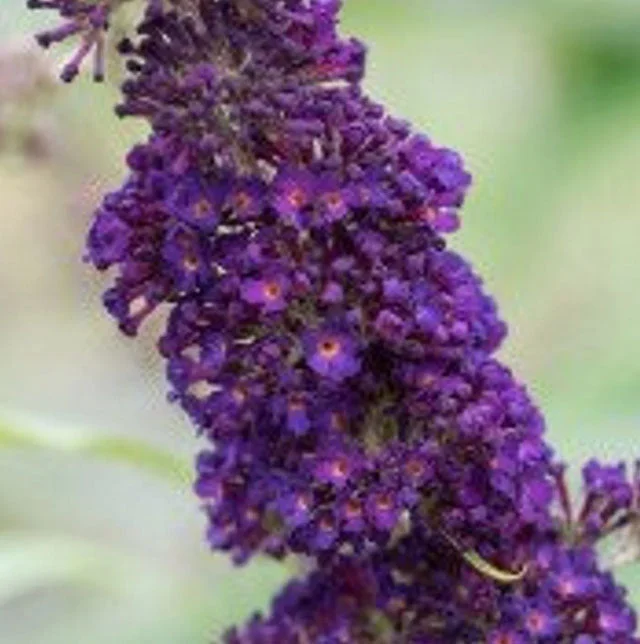
The second reason is where the flowers form. Black Knight carries its scented, deep purple panicles at the tips of the current year's growth, and flowers appear on new growth. Every bloom you get comes from stems that grew this year, so each plant needs space and light to send those stems out.
You will see advice to shear a butterfly bush into a neat green wall, the way you would a privet. We disagree. Shearing leaves old wood in place and trims off the new tips that would have flowered. A crowded, sheared row gives you a green fence with a few purple spikes on top. A properly spaced, hard-pruned row gives you flowers from the ground up.
Seven Plants and the Math Behind Them
The arithmetic is short, and once you see it, ordering gets easy. We work from the length of the line and the room each plant needs, then add one spare.
The Spacing Calculation
For a 30-foot line, we tell customers to plant 5 feet apart, center to center. Six gaps of 5 feet make 30 feet, and six gaps need seven plants, with one at each end of the line. That is our answer for a row you want to read as one solid screen from end to end.
That 5 feet sits well under the 8 to 13 feet the cultivar can reach unpruned. That is deliberate. Because you cut the row back hard every year, no plant gets to spread to its full size, and neighbors knit together at the edges by the third season. Customers usually ask us whether seven plants is too few for 30 feet. It is not. In year one it will look sparse, and by year three it will look full.
If You Want the Ends Inset
If your line runs between two structures and you would rather not have a trunk right at the corner, use six plants instead. Set the first one 2.5 feet in from the end, then space five more at 5 feet, and the last lands 2.5 feet from the other end. Two and a half plus five gaps of five plus two and a half comes to 30 feet.
Either way, we suggest keeping one extra plant growing in a pot somewhere sunny. If something goes wrong in the row, you will have a matching replacement ready, and we cover that in the last section.
Planting Day Along the Fence Line
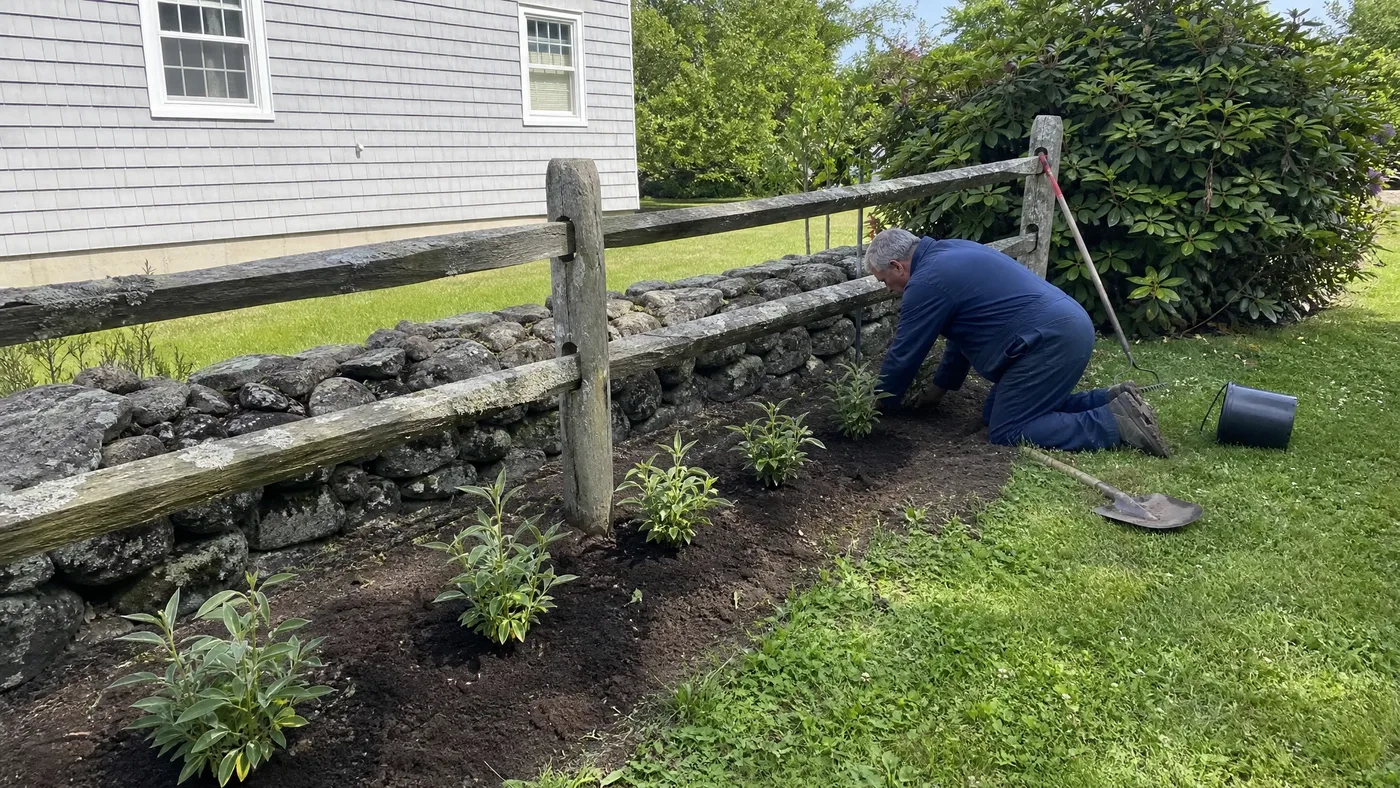
Now the fun part. Pick a day when the soil is workable and you are past the risk of a hard freeze, and check your local extension service for the dates that fit your area. Our full guide to planting a Black Knight the right way covers a single shrub, and the steps below adapt it to a row.
Mark and Dig
Stretch the tape along your planting line and push a stake or flag in the ground every 5 feet, starting at zero and ending at 30. Run a string between the end stakes if the ground is uneven. This keeps the row straight, which matters more than you would think, because a crooked row is the first thing a neighbor notices over the fence.
Dig each hole as deep as the root ball and noticeably wider, and rough up the sides with the shovel so the roots can push out. Keep the soil you dig out beside each hole. Black Knight does not need rich backfill, so refill with what you dug.
Plant, Water and Mulch
Set each shrub so the top of its root ball sits level with the surrounding ground, never buried below it. Backfill, firm the soil with your hands, and water slowly until the whole root zone is soaked. Repeat on all seven.
Then spread mulch around each plant, keeping it back from the stems so it does not hold moisture against the bark. For the first season, soak them deeply in dry spells rather than sprinkling often. Our watering guide has the details. Once established, the species is very drought tolerant, but young plants are not there yet.
The Black Knight Butterfly Bush Hedge in Its First Summer
Your first summer may look a little underwhelming, so let us reassure you now. Seven young shrubs with 5 feet between them do not look like a hedge yet. They look like seven shrubs. That is exactly right.
What to Expect
The species blooms from June to September, and Black Knight follows the same general pattern, with deep purple flower spikes that carry a sweet, honey-like scent on warm afternoons. Young plants usually bloom a little lighter than they will later. Stand near them on a sunny afternoon and you will smell the row before you see everything it brings in.
Keep watering through dry weather. Spider mites can become a problem during drought, and a stressed young shrub is the first to show it. A dusty, speckled look to the leaves is your cue to water more deeply.
Light Early Trimming
This is the year for gentle trimming only. Pinch or snip the tips of the longest shoots once or twice in early summer. That nudges each plant to branch, so you get a fuller base instead of a few tall single stems. Leave the heavy cutting for the first late winter.
Deadheading is optional, but it helps. Removing spent flower heads tidies the plant and may bring a second flush of small flowers. It also stops seed from forming, which matters because the species self-seeds and naturalizes easily. Along a property line, you do not want seedlings turning up next door.
Renewal Cuts Each Late Winter on Black Knight Butterfly Bush
This is the one yearly job that makes the whole hedge work. It feels drastic the first time, and nearly every customer who calls us about it is worried they will kill the plant. You will not.
When and How Low
Cut in late winter to early spring, before new growth gets going. The best flowers come when the plant is severely pruned in late winter, and it can be pruned hard to a low framework of permanent stems in early spring, which runs from late March to mid-April. In colder zones, lean toward the later end, and check your local extension service for your dates.
Annual hard pruning keeps this kind of butterfly bush to about 6 to 8 feet. That is your working height. Each year the row will shoot back up to roughly that, flower on the new stems, and wait for the next haircut.
Cutting the Whole Row at Once
Start at one end and work down the line so every plant ends up about the same height. Take out dead wood first, then cut the remaining stems back to the low framework. Step back every few plants and look along the row, because a level cut gives you an even screen in summer.
Don't skip a year, even if the plants looked great. A hedge left alone climbs toward that unpruned 8 to 13 feet, flowers only at the tops, and gets bare at the bottom. Our pruning guide shows the single-plant version of this cut in more detail.
When a Gap Opens in the Row
Sooner or later one plant in a row sulks. A hard winter, a wet spot or a neglected watering week can do it. Gaps are a nuisance but easy to fix, and you have options.
Replace the Plant
Before you give up on a plant, wait. Let its neighbors leaf out fully and see whether the weak one pushes new shoots from the base. If it is still bare after that, pull it, loosen the hole, and plant your spare in the same spot at the same depth.
The newcomer will be smaller than the shrubs beside it and a little shaded by them. Water it more than the others for its first season, and give it the same late-winter cut as the rest. It will catch up faster than you expect.
Fill the Gap Another Way
If you took cuttings from a neighbor and one rooted, plant that in the gap. If you would rather not wait, tuck in a companion shrub or a clump of tall ornamental grass. Both can break up the line in a pleasing way. Our companion plant ideas will help you choose something that likes the same full sun.
Your Finished Black Knight Butterfly Bush Screen
By the third summer, the row we have described will look like a hedge. Seven plants, cut to a low framework each late winter, rise to roughly 6 to 8 feet, knit together along the 5-foot spacing, and carry deep purple, scented flowers from June into early fall. Left alone, the same plants would aim for the 8 to 13 feet the size guide describes, so the yearly cut is what keeps your screen the height you chose.
Black Knight Butterfly Bush
Nursery-grown Black Knight Butterfly Bush in sizes from Quart Plant, shipped to your door.
From $49.49
Shop Now →A 30-foot screen is just a few seasons and one yearly haircut away. Measure the line, give the plants room, and trust the pruners each late winter. If you get stuck anywhere along the way, write in with your questions and we will happily talk it through. Every Black Knight we ship is potted with a healthy root system, packed to protect its stems and roots in transit, and sent so it arrives ready to plant along your fence.